We love the positive impact of Botanical dyes, and we love their painterly beauty and effect on textiles.
When we started our journey into botanical dyeing in 2021, we were honored to collaborate with local establishments and women owned businesses, Maria's Kitchen and the Shelter Island Florist, as well as Sylvester Manor, all on Shelter Island, NY, to use their food waste and floral waste in order to create our botanical dyes. It was an experiment at the time, exploring another responsible way of creating whilst offering one of a kind color and print.
It started as a story of community, nature's healing powers, as we were transitioning out of COVID. It was and is about creating with positive impact, women empowering women, whilst creating art and product we are proud to wear, and staying true to our sustainability goals.


Madder Root- another favorite


Botanical dyes are extracted from nature, each with their own individual backstory.
Botanical dyes are safe for the environment as they reduce the amount of harsh chemicals and colorants that would otherwise enter into the planet’s water systems.

The Botanical colors are sustainably derived, renewable, harmlessly biodegradable, and non-toxic. We use a water-efficient garment dyeing method and any remaining wastewater is non-toxic.
These dyes can help transform the way we use colorants in everyday products, RE-imagine our approach to creation thus reducing waste, and encourage the shift towards a more responsible system of production and consumption.
We are proud to use botanical hand dyeing methods whenever possible.
Here are a few of our favorites.
Weld
A native of Europe and Western Asia, the plant can also be found in North America as an introduced species and common weed. While other resedas were used for the purpose, this species was the most widely used source of the natural dye known as weld. The plant is rich in luteolin a flavonoid which produces a bright yellow dye. The yellow could be mixed with the blue from woad (Isatis tinctoria) to produce greens such as Lincoln Green.
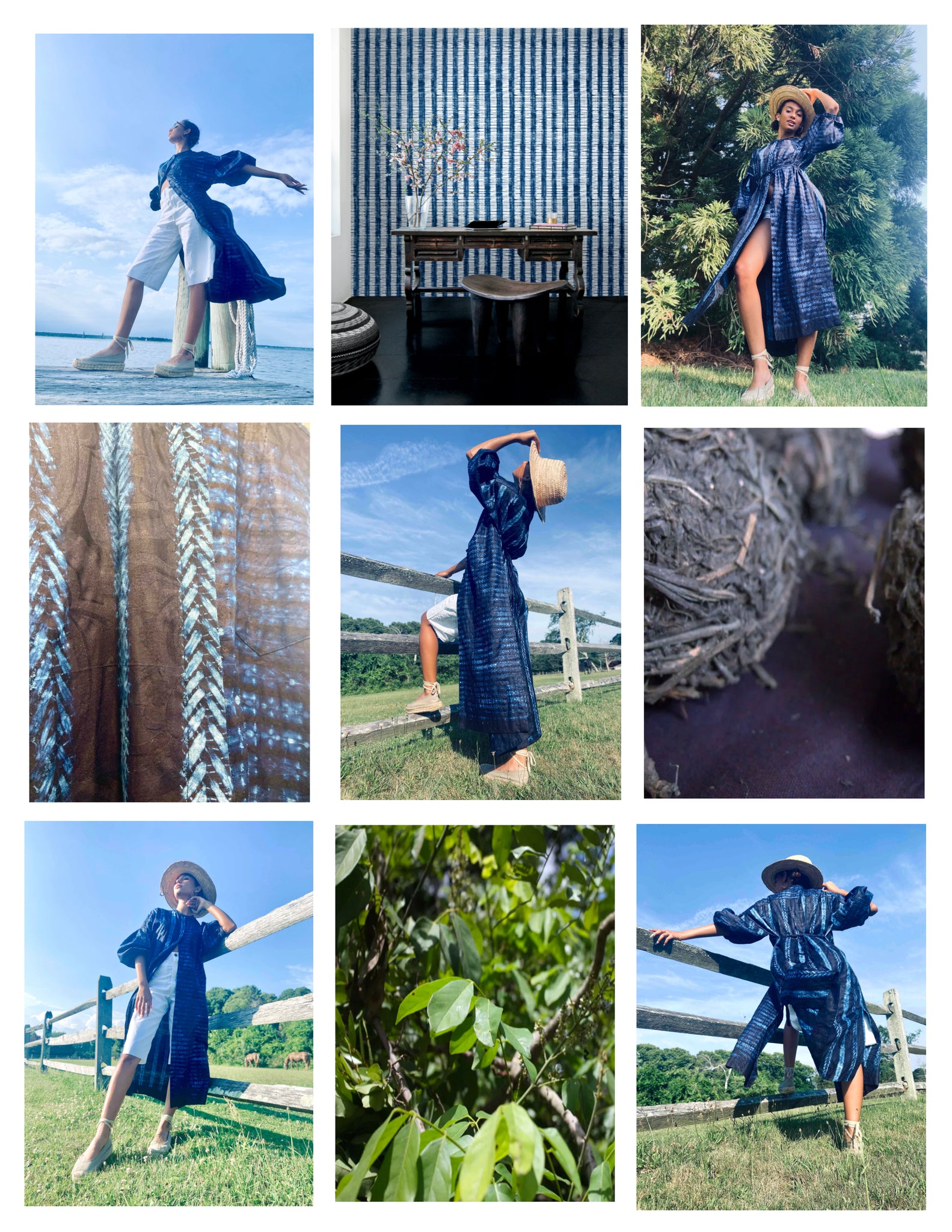
Adire Alabare with Natural Indigo
Àdìrẹ are indigo-dyed cotton cloths decorated using a resist-dying technique to create striking patterns in blue and white. They were traditionally made and worn by women throughout the Yoruba region of south-western Nigeria, West Africa. The cloths were usually made up of two strips of factory-produced cotton, sewn together to form a shape that was roughly square, and worn as wraps around the body.
The cloths are usually prepared, and always dyed, by women. Their bright colour comes from imported indigo grains or locally-grown indigo leaves, which were fermented and mixed with water softened with caustic soda to make a dye.
The cloth would be dipped into a large pot of dye, and then pulled out to allow it to oxidise – a process which could be repeated to make the colour darker. Sometimes after it had been dyed the cloth would be beaten with a mallet so it took on a sheen.
The term àdìrẹ alabare is used when sewing is the means to resist the dye. Women handstitch or tie the fabric using raffia to create various stitch resist prints.

Botanical dyeing using local plants, on cashmere and merino wool


Food waste dye
Yellow represents sunshine, happiness and warmth and we embrace it !
We love a combo of onion skin, turmeric and avocado waste to create 'Sunshine', the sunniest of yellow tones with amber tones.

Floral and Food waste dye
We love a great mix- combining floral and food waste to create a wonderful botanical print.

Fermented Persimmon dye
Kakishibu is a traditional japanese dyeing method using the discoloration caused by oxidation of the fermented juice of unripened persimmon fruit containing strong tannin. It also reacts to sunlight, so the color changes slowly with time and sun exposure.
Kakishibu has many natural, beneficial properties.
Kakishibu dye is antiseptic, insect repellent, mildew-proof and water resistant. The color deepens and develops a beautiful patina over years.

Vintage Indigo dye
We use a pure indigo pigment that is extracted from fresh leaves of Indigofera Tinctoria through the process of fermentation and precipitation. The indigo we use is from Burkina Faso on our handloom cottons and Southern India for our knits.


Copper Botanical
During Beetroot season, we collaborated with Sylvester Manor Farm on Shelter Island and harvested gorgeous beets too small to eat, but perfect for botanical dyeing.


Stay tuned as we continue our journey learning, discovering and sharing our Botanical State of Mind.
